Live Illustration for University College London: Teaching Disinformation
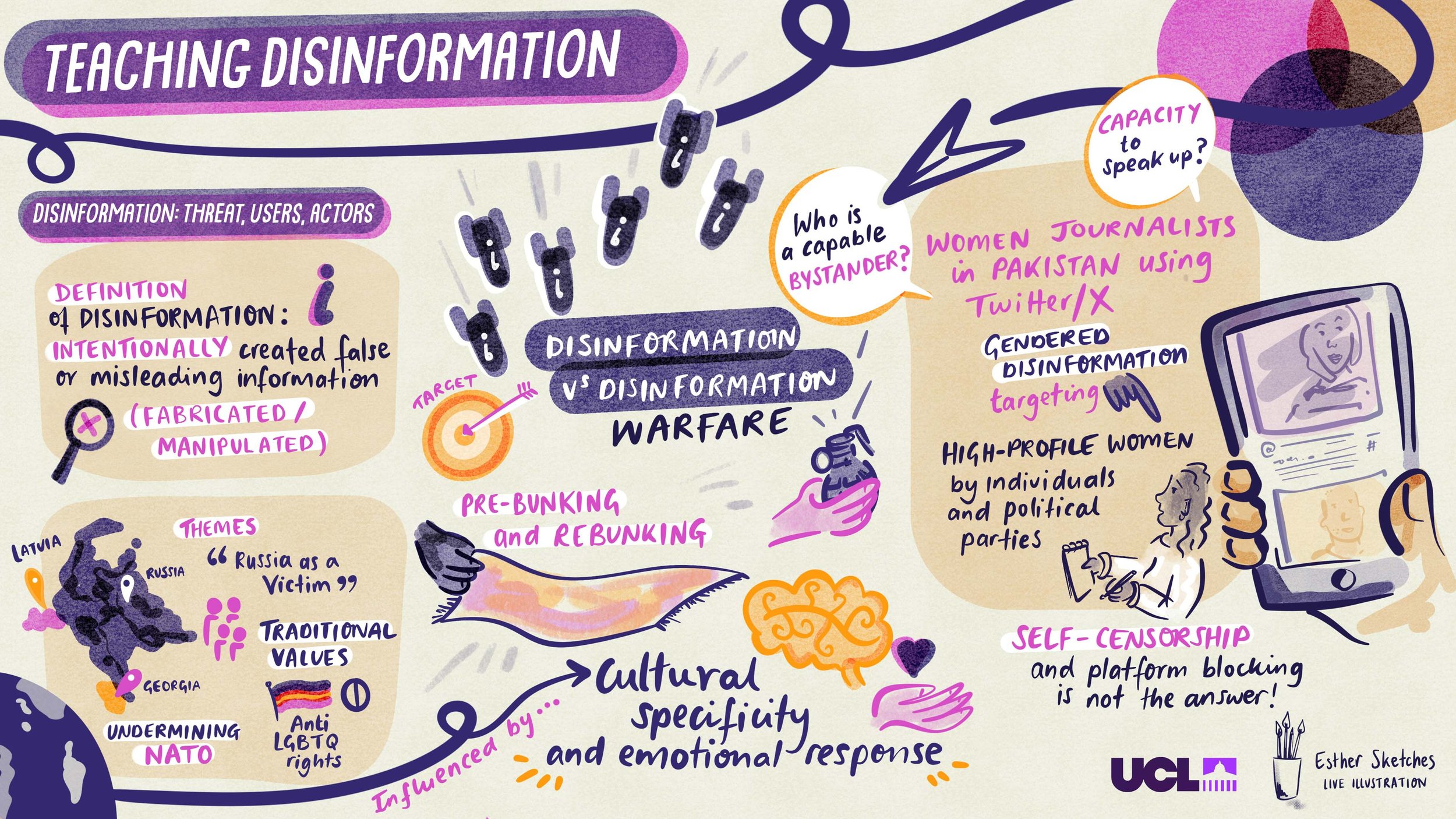
I recently created live illustrations for University College London at a conference exploring how disinformation can be taught across different academic and educational settings.
Several UCL departments came together for the event, with the aim of beginning a conversation around how to teach disinformation and how this subject might be developed into a teaching module across areas such as media studies, technology and engineering.
It was a fascinating, fast-moving day that brought together academics, journalists and technologists to explore what disinformation means, how it differs from misinformation and malinformation, and how it can be approached from a teaching perspective.
Why disinformation is such a complex subject to teach
Disinformation is not a new or contemporary phenomenon; deliberate deception and propaganda have existed throughout human history. However, the digital era has radically transformed its scale, speed and impact.
Disinformation is something we see discussed more and more often, particularly in relation to inaccurate news, online content, digital platforms and the spread of misleading information. But teaching disinformation is not straightforward.
It involves questions around media literacy, technology, ethics, journalism, public understanding, online behaviour and how people learn to question the information they encounter.
For this event, the conversation looked at how these issues might be explored from secondary school through to university level, and how educators might begin to develop a meaningful approach to teaching the subject.
It was not a simple topic with simple answers. Which is exactly where live illustration can be so useful.
Capturing a dynamic day through live illustration
Throughout the conference, I created three live illustrated panels, capturing the ideas, questions and themes emerging throughout the day.
The event included multiple speakers and perspectives, with conversations moving quickly between academic, journalistic and technological viewpoints.
My role was to listen carefully, keep pace with the discussion and translate complex spoken content into a visual form that could help people see the bigger picture.
When I’m live illustrating I’m not capturing every single word. That’s impossible and not necessary! What I’m actually doing is employing critical thinking skills to decipher what’s relevant and crucial to give a top-line insight into the topic. The genuine breakthrough areas of insight and the commonly held sentiments in the room.
That might be a recurring theme, a key question, a moment of tension, a memorable phrase or an idea that connects different parts of the conversation.
At an event like this, where people are exploring complex and evolving subject, the illustration becomes a way of holding the conversation as it unfolds.

Making complex conversations easier to follow
Academic and research-led events often involve specialist language, multiple perspectives and a lot of information being shared in a short space of time.
Live illustration helps by creating a shared visual record that people can return to throughout the day.
For events exploring subjects such as disinformation, technology, media literacy or education, this can be especially valuable because it helps to:
make complex ideas easier to follow
identify common themes across different speakers
capture questions and tensions as they emerge
show how different perspectives connect
create a memorable visual summary of the day
provide organisers with a resource they can share after the event
Instead of the discussion disappearing into notes, slides or memory, live illustration makes the thinking visible.
Keeping pace with fast-moving conversations
One of the biggest skills in live illustration is keeping up. During the UCL event, the speakers were passionate, the subject matter was detailed and the conversations moved quickly. That is part of the challenge, and part of the value.
As a live illustrator, I am constantly listening, filtering, interpreting and deciding what needs to be captured visually. It is not simply a case of drawing what is being said.
When a topic is complex, visual storytelling can help people step back and see the shape of the discussion.
Live illustration for universities, research events and conferences
This project is a great example of how live illustration can support universities, academic institutions and research-led organisations. Whether you are hosting a conference, workshop, panel discussion or knowledge-sharing event, graphic recording can help people engage with complex material in a more accessible way. It can support events focused on:
research communication
education and teaching
technology and society
media literacy
policy discussions
interdisciplinary collaboration
stakeholder engagement
public-facing research
When people from different disciplines come together, live illustration can help create a shared point of reference.
It allows participants to see what has been discussed, recognise connections between ideas and leave with a visual record of the conversation.
”We recently worked with Esther for our recent workshop - she was exceptionally accommodating and flexible with our requests and added lots of colour and life to the discussions and presentations! Really grateful and impressed by all the illustrations and designs. Thank you Esther!”
Ellie Wong, UCL

Looking for a live illustrator for your academic event?
If you are planning a university conference, research showcase, panel discussion or workshop, live illustration can help you capture the ideas in the room as they happen.
It can make complex conversations more accessible, memorable and engaging, while creating a lasting visual resource that can be shared after the event.
